



Janurary 26, 2026
By Nourbese Flint, President
Have more babies. Do your duty. Save civilization. And crucially: which civilization is being saved is never left vague for long
Reproductive justice is often flattened into a single issue—abortion—but that erasure is itself political. In reality, reproductive justice rests on three equally essential pillars:
1. the right to have a child,
2. the right not to have a child,
3. the right to raise children in safe, dignified conditions.
Remove any one of these and freedom becomes theoretical rather than real. Autonomy does not exist if parenthood is coerced, if childlessness is punished, or if families don’t have the social structures required to sustain them.
That framework is essential for understanding the modern resurgence of pronatalism.
At first glance, contemporary pronatalism presents itself as a benign—or even benevolent—concern about declining birth rates. Who, after all, wants an aging society with fewer workers, fewer caregivers, fewer children? But beneath the surface, this movement is not asking why people are choosing not to have children—rising housing costs, stagnant wages, inaccessible childcare, medical debt, climate anxiety. Instead, it skips directly to moral pressure. Have more babies. Do your duty. Save civilization. And crucially: which civilization is being saved is never left vague for long.
The modern pronatalist narrative disproportionately centers white, Christian, heterosexual families, with women encouraged—sometimes sweetly, sometimes viciously —to trade careers for caregiving and ambition for domestic virtue. Paid leave, universal childcare, healthcare access, or living wages are conspicuously absent from the conversation. While motherhood is elevated; mothers themselves are not supported.
This is not new.
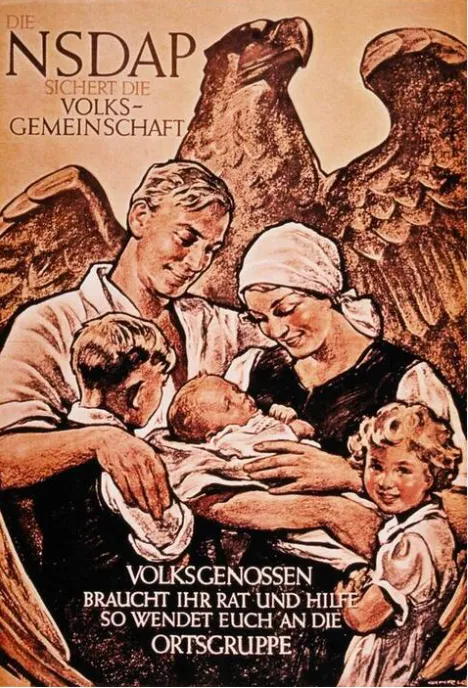
Nazi Germany offers one of the clearest historical examples of state-driven pronatalism. The regime explicitly tied reproduction to racial ideology, promoting childbirth among “Aryan” women while violently preventing it among Jews, Roma people, disabled people, and others deemed undesirable. Policies included marriage loans forgiven with each child, bans on abortion and contraception for “racially valuable” women, and state honors like the Mother’s Cross awarded to women who produced four or more children for the Reich. The Lebensborn program went further still, using state resources to engineer the reproduction of racially “pure” offspring.
Although, The United States does not need to look to Nazi Germany to find a legacy of reproductive control. I mean, who did the Nazi’s get their ideas from. Yep that’s right, the good old USA. We perfected our own version of eugenics—quieter, bureaucratic, and just as devastating.
For much of the twentieth century, the U.S. openly practiced eugenics, disproportionately targeting Black women in the South, Latinas in California, Indigenous women nationwide, and women in U.S. territories like Puerto Rico. Under the guise of public health, poverty reduction, or “fitness,” thousands were sterilized without consent—or with consent extracted through coercion, misinformation, or outright deception.
In the Jim Crow South, Black women were subjected to involuntary hysterectomies so routinely they earned a grim nickname: the “Mississippi appendectomy.” These procedures were often performed without explanation, framed as medically necessary, or carried out while women were under anesthesia for unrelated care. The goal was explicit—to reduce the reproduction of people the state deemed poor, Black, or “dependent.”
In California, the epicenter of U.S. eugenics policy, state institutions forcibly sterilized tens of thousands of people well into the 1970s, with Latinas disproportionately targeted. Doctors and social workers justified these acts by citing welfare use, immigration status, or assumptions about intelligence and morality. These were not fringe practices; they were state-sanctioned and legally defended. And in some cases went on well into the 2000s
Puerto Rico offers another chilling example. Beginning in the mid-20th century, mass sterilization campaigns were promoted as economic modernization. By the 1970s, an estimated one-third of Puerto Rican women of childbearing age had been sterilized, often without fully informed consent. The island was also used as a testing ground for early birth control pills—high-dose formulations trialed on poor women with limited disclosure of risks. Reproductive control here was colonial policy dressed up as progress.
This is the uncomfortable truth modern pronatalists avoid: the United States has never been neutral about reproduction. It has consistently encouraged childbirth among those it values and prevented it among those it devalues. That is eugenics—not always in name, but always in function.
Which makes today’s pronatalist panic deeply revealing. The concern is not that people aren’t having babies. It’s that the wrong people are having fewer.
Pronatalism here was not about love of children. It was about demographic control, national strength, and the regulation of women’s bodies in service of ideology.
Fast-forward to the present, and the messaging has been rebranded but not reinvented.
Today’s version comes wrapped in the language of “soft life,” “traditional femininity,” and claims that “real feminism” is found in motherhood alone. Media outlets like Evie Magazine market submission as empowerment, while much of the MAHA/New age Feminism ecosystem reframes reproduction as wellness, morality, or cultural restoration. The through-line is consistent: fulfillment is domestic, ambition is suspect, and autonomy is best exercised within narrowly defined gender roles.
The most insidious part is not the aesthetic though it’s the funding and power the movement now has.
Many of the loudest voices promoting pronatalism are billionaire men with enormous economic and political influence. Elon Musk has repeatedly warned of “population collapse,” framing reproduction as a civilizational emergency while opposing labor protections and social safety nets that would actually make parenting viable for most people. JD Vance has argued publicly that people without children should have less political power, once deriding “childless cat ladies” as uninvested in the nation’s future. These are not neutral observations; they are value judgments about whose lives count.
And they align neatly with material interests.
Children remain the single biggest reason women leave the workforce. Encouraging higher birth rates without restructuring labor, caregiving, and social policy predictably results in women’s economic dependence and reduced political power. When birth is emphasized without support, control fills the gap. It is not about everyone having babies. It is about certain people having babies—and others absorbing the cost.
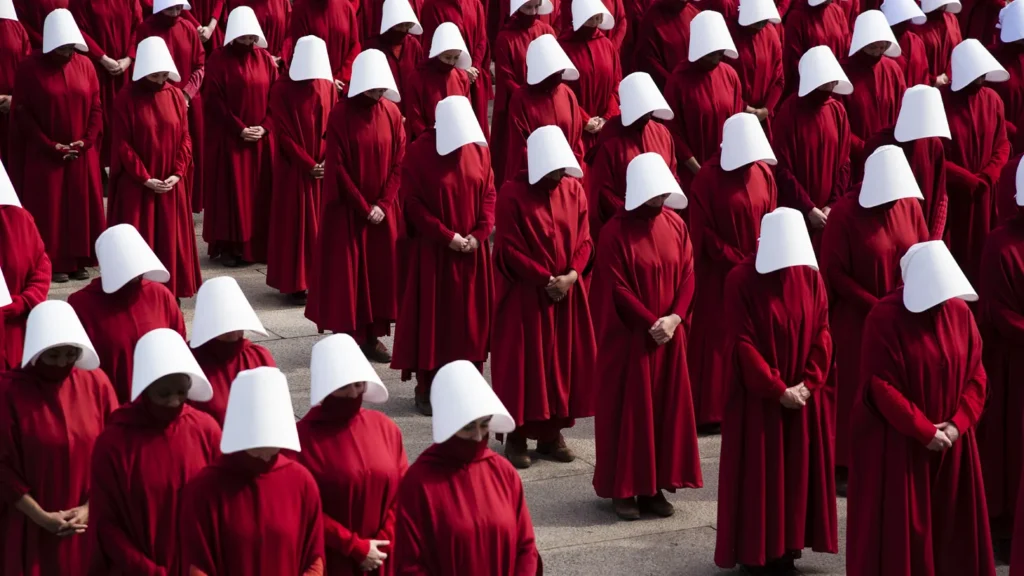
So does this sound vaguely familiar. Like did you read a book or see a tv show about this? And yes, yes you have. In one of the scariest forms of life imitating art in the Handmaid’s Tale. Margaret Atwood has been clear that nothing in the novel was invented; every mechanism of control depicted has historical precedent. The lesson is not that dystopia arrives overnight, but that it advances incrementally, disguised as tradition, necessity, or moral concern. When women’s bodies become instruments of state or cultural survival, autonomy becomes conditional. Rights become privileges. Choice becomes an illusion. The warning is clear
If we fail to defend all three pillars of reproductive justice—autonomy, support, and dignity—we do not get a future full of children. We get a future where reproduction is compelled, caregiving is unpaid, and freedom is selectively distributed. History has already run this experiment. The results were not charming.
Pronatalism needs to be confronted with reality: people don’t need pressure to have children. They need safety, equity, and the ability to choose their lives without fear. Anything else is not pro-family. It’s just control—with a baby blanket draped over it.